


In brief
- The price of hyaluronic acid for the forehead is not uniform and depends on the type of product, the number of syringes, the complexity of the anatomy and the doctor's experience.
- A dynamic wrinkle that appears only with movement is usually treated by relaxing the muscle, while a static wrinkle that is visible at rest may be suitable for gentle filling.
- The treatment takes about 30 minutes, with the option of local anaesthesia, and is performed with a fine needle or a cannula.
- The product lasts on average between 12 and 18 months, and effects such as redness and mild swelling usually fade within a few days.
- Forehead treatment requires precision and conservative judgement, so you should not choose a clinic on price alone.
A patient sits opposite me in a consultation and asks two practical questions: how much will it cost me, and how will I know my forehead is in the right hands? These are exactly the questions you should ask before treatment in a delicate area like the forehead.
The price of hyaluronic acid for the forehead is not uniform, and rightly so. It is affected by the type of product, the number of syringes required, the complexity of the anatomy, whether it is a targeted treatment of a static wrinkle or a broader correction of a hollow and loss of support, and also the level of experience of the doctor performing it. On the forehead, choosing on price alone can prove costly, because this is an area where even a small injection requires a high degree of precision and conservative judgement.
A professional clinic does not just price a "syringe". It prices diagnosis, planning, the right choice of product, a safe injection technique and proper follow-up after the treatment.
This is a practical point that many patients miss. If an offer is particularly cheap, it is worth checking exactly what is included. Is it a well-known, approved product? Is there a proper consultation? Does the doctor explain when hyaluronic acid is suitable and when another treatment is preferable? And is someone available to respond if an unusual reaction occurs after the injection?
How do you choose a professional clinic in practice? First of all, check who performs the treatment, what experience they have with injections in high-risk areas, and whether they can explain the clinical reasoning behind the recommendation. On the forehead, the right answer is not always filler. Sometimes the wrinkle is mainly caused by muscle activity, in which case Botox will be the better choice. Sometimes there is also an element of volume loss or poor skin quality, in which case hyaluronic acid can be a precise treatment, or part of a combined plan.
It is also important to pay attention to the conversation itself. An experienced doctor will not promise a "completely smooth" forehead in every case, and will not push for treatment if the anatomy or your pattern of expression makes filler less suitable. The conversation should cover the limits of the treatment, possible risks, the option of gradual treatment and a clear follow-up plan.
At Dermacare, the decision on forehead treatment is made after a full clinical assessment, not on the basis of a photo or a general request to "fill a wrinkle". We assess skin quality, the depth of the wrinkle at rest, muscle movement, the structure of the forehead and previous treatment history. Only then do we decide whether hyaluronic acid is the right choice, a complementary treatment, or an option best avoided.
Ultimately, good forehead treatment is measured less by the initial price and more by the quality of the decision-making. The result I aim for is a fresh, natural and safe-looking forehead, with a treatment that suits your facial structure rather than a fixed template.
Introduction: when do forehead lines turn from 'expression lines' into permanent wrinkles?
Forehead wrinkles usually start as expression lines. They appear when the forehead muscle is working, for example when raising your eyebrows, in surprise or when concentrating. Over time, and especially as the skin loses support, hydration and collagen, the same lines start to remain at rest too.
Hyaluronic acid is a natural substance found in the human body. In an aesthetic context, it is used to fill wrinkles and smooth the skin of the forehead. According to clinical information, from the age of 30 the body slows down its production of collagen, and by the age of 40 production almost stops altogether, which contributes to the appearance of expression lines and permanent wrinkles in the area.
The important point is the distinction between two different situations:
-
A dynamic wrinkle. Appears only with movement, so the main treatment will sometimes be muscle relaxation.
-
A static wrinkle. Visible even when the face is at rest, so gentle filling of the tissue itself is sometimes needed.
This is exactly where hyaluronic acid for the forehead comes in. It does not just "cover" a wrinkle, but can support an area that has lost volume and improve the appearance of the skin in a measured way.
Understanding the anatomy of the forehead: why wrinkles form and how hyaluronic acid works
The forehead is a very active area. The frontal muscle of the forehead works almost every day, often without us noticing. When the skin is younger and more elastic, it springs back easily. When the tissue becomes thinner, every repeated movement leaves a clearer mark.

What happens to the tissue over time
Natural hyaluronic acid is found in the skin and contributes to hydration, elasticity and support. Over the years its natural reserves gradually decline, and collagen weakens as well. There is a decline of about 1% a year in the production of natural hyaluronic acid from the age of 30, which contributes to volume loss in the forehead.
The result is not just "a wrinkle". Sometimes the forehead looks slightly hollow and less even, with grooves etched into the skin. This is the difference between a treatment that relaxes a muscle and a treatment that restores support to the tissue.
How the treatment works in practice
When hyaluronic acid is injected into the forehead correctly, the product gently fills the hollow, binds water and supports the area. It is not just mechanical filling but also has an effect on tissue quality.
Hyaluronic acid injected into the forehead also acts as a deep biostimulator, stimulating the production of natural type I and type III collagen by stretching fibroblasts. Clinical studies show an increase of 20-40% in collagen in the treated area 3-6 months after injection.
With permanent forehead wrinkles, the right question is not just "how do we smooth them", but "why does the wrinkle remain at rest". The answer determines the treatment.
Why the injector's skill is especially important
The forehead is not a simple area to inject. It has delicate anatomy, blood vessels and significant muscle movement. That is why not every forehead wrinkle needs filler, and not every product suits every patient.
In practice, the right treatment starts by looking at the whole picture: the depth of the wrinkle, skin quality, the degree of volume loss, the pattern of expression and whether a complementary treatment is needed. In some cases hyaluronic acid is the main choice. In others it complements another treatment rather than replacing it.
The treatment process at Dermacare, from consultation to result
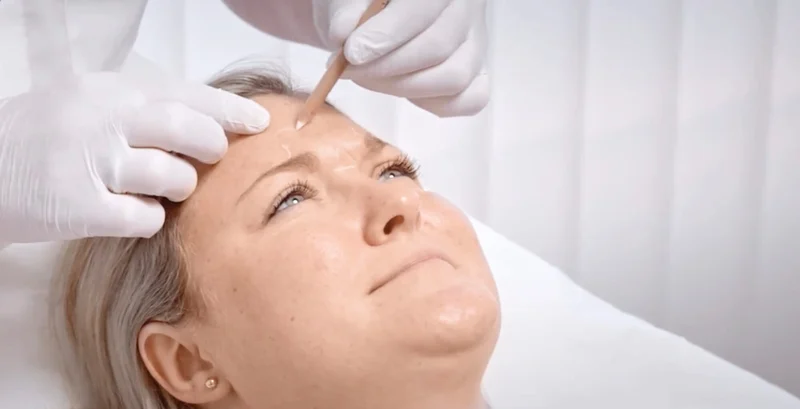
In the consultation we do not just look at the lines on the forehead. We check how the forehead looks at rest, how it behaves in movement, how thick the skin is, whether there is any asymmetry, and to what extent the wrinkle is caused by volume loss as opposed to muscle activity.
This stage is more important than the injection itself. If the diagnosis is not accurate, it is easy to choose a treatment that looks right on paper but does not solve the real problem.

What we check before deciding
There are several classic scenarios:
-
A good candidate for forehead filler. A wrinkle that remains even without expression, a slight hollow or skin texture that has lost support.
-
A case better suited to muscle relaxation. Lines that are visible only when raising the eyebrows, without a permanent groove at rest.
-
A situation that requires a combination. Both a very active muscle and a wrinkle that has already become established.
In such cases you can also consider a combined wrinkle treatment with hyaluronic acid, where the aim is to balance support for the tissue with control of expression.
What the injection itself looks like
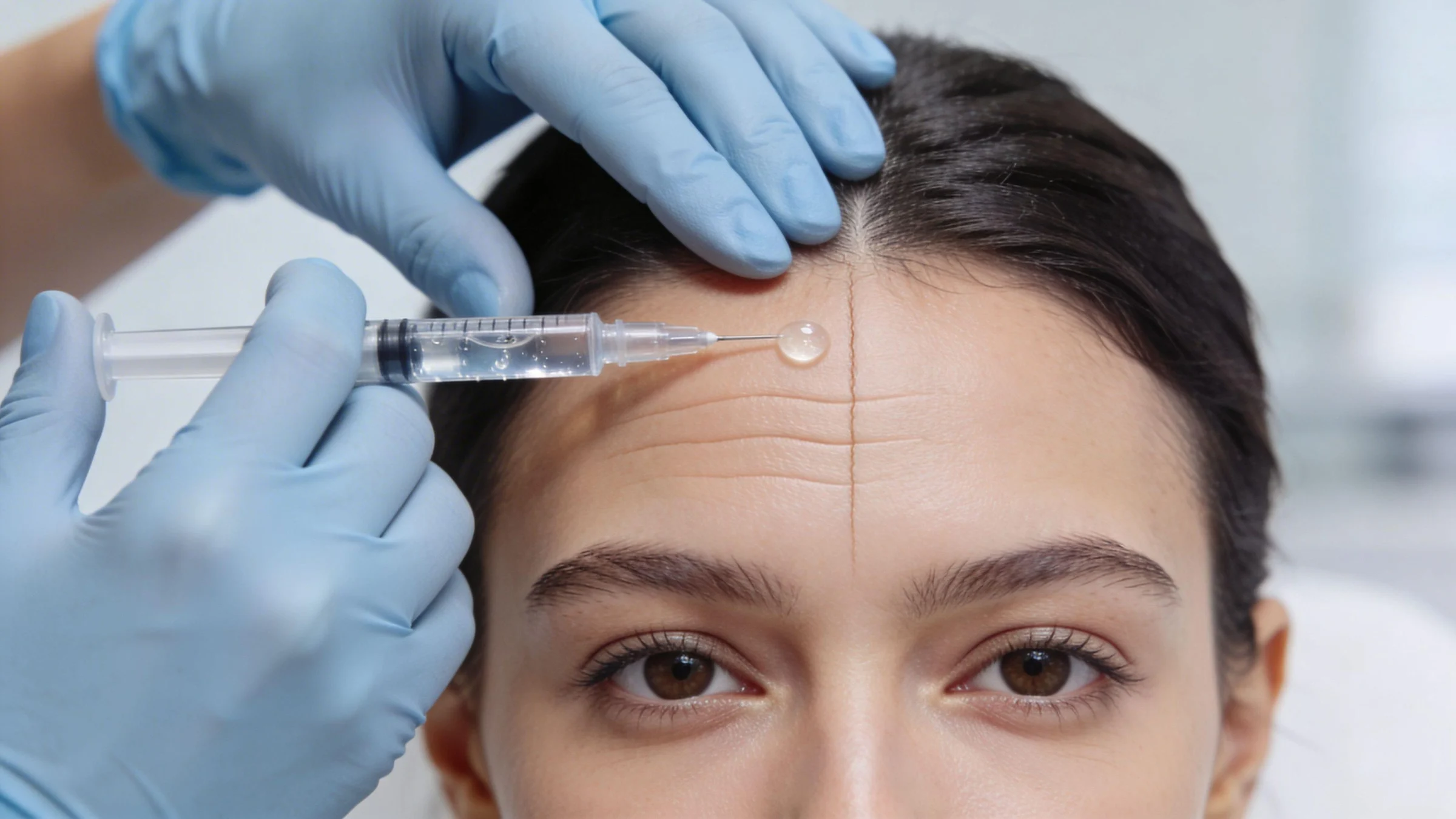
The treatment takes about 30 minutes, with the option of local anaesthesia, and is performed with a fine needle or a cannula for optimal precision.
In practice, the choice between a needle and a cannula depends on the anatomy, the depth of the correction and the purpose of the injection. In some cases a cannula allows gentler work, with less trauma to the tissue and a more even distribution of the product.
Rule of thumb: on the forehead, we do not aim to "make everything disappear" in one go. We aim for a precise improvement that respects movement and facial structure.
What happens immediately afterwards
In most cases a change is visible by the end of the treatment. However, the initial result is not always the final result. Sometimes there is a little local swelling, and sometimes the area needs a few days to settle.
This is where conservative planning matters. On the forehead, a natural result usually comes from measured rather than aggressive filling. This is an area where excess product quickly becomes noticeable, which is why clinical experience is very important.
Who is forehead wrinkle filling suitable for?
Not everyone who is bothered by their forehead needs hyaluronic acid. A good fit is based on the type of wrinkle, the condition of the skin, facial structure and what you expect from the treatment.
The treatment is generally suitable for women and men, usually from the age of 30, who have a static forehead wrinkle, a slight loss of volume or a wish to soften a tired appearance without undergoing surgery.
Situations in which the treatment may be suitable
-
Wrinkles that are visible even at rest. This is the classic sign that it is not just an active muscle.
-
Slight volume loss in the forehead. An area that looks slightly hollow or creates shadowing.
-
Skin that has lost quality and support. When the goal is not only a smoother line but also softer, more even-looking skin.
Tailoring the treatment depends heavily on skin type, baseline hydration level, sun exposure and genetics. A preliminary diagnosis, sometimes with the help of technology, is therefore important for determining the type of product and realistic expectations.
When it is less suitable
There are cases in which hyaluronic acid for the forehead is not the first treatment:
-
If the lines appear only with movement. In this case muscle relaxation is usually the basis.
-
If there is an expectation of a "frozen" or completely smooth forehead. This expectation does not fit a treatment whose aim is a natural look.
-
If there is an active medical condition in the area. For example a local infection, significant irritation or a medical condition that needs to be investigated before treatment.
Pregnancy, breastfeeding or an active autoimmune disease also require postponement or an individual medical assessment.
What actually affects the result
How long the result lasts is not the same for everyone. Differences in skin quality, metabolism, sun exposure and lifestyle habits all affect how the product behaves in the tissue.
If you are deciding between several options, you may also find Dermacare's guide which anti-aging treatment is right for me helpful, especially if there is a combination of wrinkles, skin quality and volume loss.
A good result is not just about how much the wrinkle has softened. It is also about whether the forehead still looks like it belongs to your face.
Results, recovery, side effects and risks
One of the clear advantages of hyaluronic acid for the forehead is that you see a change quickly. According to this review, the results are visible immediately and settle within a few days. The product lasts between six months and two years, depending on genetics, the type of product and lifestyle.

What recovery looks like
In most cases you can return to your routine quickly. There may be redness, local sensitivity, mild swelling or a small mark at the injection point. These effects usually fade within a few days.
In terms of how long it lasts, hyaluronic acid in the forehead lasts on average between 12 and 18 months, and factors such as smoking and heavy sun exposure may shorten this, while maintenance treatments can extend the result, as stated in the encyclopaedia entry on hyaluronic acid.
Aftercare instructions are usually simple:
-
Avoid pressure on the area for the first few hours.
-
Postpone strenuous physical activity for a short time, as instructed by your practitioner.
-
Reduce exposure to heat and sun in the period close to the treatment.
-
Watch for any unusual change and do not "wait for it to pass" if in doubt.
Risks you should know about
Most side effects are mild and temporary. However, this is a medical procedure, not a simple cosmetic treatment. The more significant risks are rare, but they call for a high level of skill and an excellent knowledge of the anatomy of the forehead.
In the second half of 2018, about 70,000 hyaluronic acid injections were given in Israel, and of these, 68 patients were hospitalised due to complications, as stated in the same encyclopaedia entry on hyaluronic acid. This is exactly why such a treatment should not be chosen on price alone.
A brief comparison of forehead treatment types
| Parameter | Hyaluronic acid | Botox | Biostimulators |
|---|---|---|---|
| Mechanism of action | Filling and supporting the tissue | Muscle relaxation | Stimulating collagen building |
| Mainly suitable for | Static wrinkles and volume loss | Dynamic wrinkles | Improving skin quality and gradual support |
| Speed of results | Usually immediate | Gradual | More gradual |
| Nature of the result | Softening hollows and restoring volume | Reduced movement | Improved texture and firmness |
On the forehead, safety comes before any other consideration. A beautiful result that was not achieved correctly is not a success.
Comparison with the alternatives: hyaluronic acid vs Botox and biostimulators
This is the dilemma most patients come with. "If I have a wrinkle on my forehead, why not just have Botox?" The answer is that it depends on the source of the wrinkle. If the problem is muscle movement, Botox can be the core of the treatment. If the problem is a groove that remains at rest, volume loss or poor skin quality, hyaluronic acid may be more precise.
The fundamental difference between the treatments
Botox does not fill a hollow. It reduces the activity of the muscle that created the line. That is why it is particularly effective when the wrinkle is "written" only during expression.
Hyaluronic acid does not paralyse a muscle. It adds support to the tissue and softens the groove itself. On the forehead this is an advantage when there is a static wrinkle, but also a limitation, because you need to know exactly where and how much to inject.
Biostimulators belong to a different category. They are mainly intended to stimulate building processes and improve tissue quality over time. They are less suitable for those looking for immediate filling of a specific line on the forehead.
Quick comparison: hyaluronic acid, Botox and biostimulators for the forehead
| Parameter | Hyaluronic acid | Botox (botulinum toxin) | Biostimulators (Radiesse/Sculptra) |
|---|---|---|---|
| Mechanism of action | Filling hollows, restoring volume, improving support | Relaxing the muscle that causes the wrinkle | Stimulating collagen production |
| Type of wrinkle treated | Static wrinkle, hollow, volume loss | Dynamic wrinkle | Decline in tissue quality |
| Time until results appear | Usually immediate | Gradual | More gradual |
| Final appearance | Softened line and tissue support | Less forehead movement | Overall improvement in texture and firmness |
| When I would choose it | When there is a wrinkle that remains even without expression | When a wrinkle appears mainly with movement | When looking for gradual tissue change |
What usually works and what works less well
What works is matching the treatment to the mechanism of the problem. What does not work is trying to solve every wrinkle with the same tool. A patient with a permanent groove in the forehead will not always be satisfied with muscle relaxation alone. On the other hand, a patient with only strong forehead movement does not necessarily need filler.
Choosing a professional clinic is especially important here. Not because the treatment is "luxurious", but because the forehead is an area where medical judgement, anatomical precision and gentle technique directly affect safety and the result.
How much does the treatment cost and how do you choose a professional clinic?
The cost of hyaluronic acid for the forehead is not uniform. It depends on the type of product, the amount required, the complexity of the area, the technique chosen and the practitioner's experience. On the forehead, a price that is too low should prompt caution, not enthusiasm.
The reason is simple. This is not an area where it pays to "buy a special offer". According to Ministry of Health data, in the second half of 2018 alone 68 patients were hospitalised due to complications from injections, as cited in the encyclopaedia entry on hyaluronic acid. This figure highlights how important it is to choose a qualified doctor and a clinic that works with approved products and a proper medical protocol.
How to choose correctly
-
Check who performs the treatment. It is important that it is a professional with specific experience in facial injections.
-
Ask how the treatment decision is made. If there is no proper diagnosis of the type of wrinkle, that is a bad sign.
-
Find out which products are used. An approved, well-known and documented product is just as important as the technique.
-
Ask for an explanation of the risks and of a correction plan if needed. A serious clinic does not avoid this conversation.
Those who also compare other treatments for the forehead often ask about relative costs compared with muscle-relaxing treatments. In this context, you can also read about the costs of forehead Botox, to understand what affects the financial decision over time.
Four practical questions patients ask
Can I go back to work the same day?
In most cases yes, as long as you are fine with the possibility of mild redness or a small mark at the injection site.
If the result is too strong, can anything be done?
Yes. One of the advantages of hyaluronic acid is that it can be adjusted or dissolved as needed, subject to a medical decision.
Does the treatment need to be repeated regularly?
Not on a fixed schedule for everyone. Follow-up is determined according to how long the product lasts, the condition of the tissue and the aesthetic goal.
Can it be combined with other treatments?
Sometimes, yes. In certain cases, combining it with another treatment gives a more precise result than using a single tool.
Summary: the path to a smooth forehead and a fresh look
Hyaluronic acid for the forehead can be a very precise solution for permanent wrinkles, volume loss and improving skin quality, but only when it truly suits the problem. On the forehead, more than in other areas, the difference between the right and the wrong treatment begins with the diagnosis and ends with skill.
If you are considering forehead treatment, do not settle for the question "which product is injected". The important questions are what is causing the wrinkle, whether there is volume loss, whether a complementary treatment is needed, and what the realistic and safe result is for you. The right consultation saves unnecessary treatments, reduces risk and helps build a plan that suits your facial structure rather than a trend.
Want to find out exactly what is right for you? The Dermacare team will be happy to assess the condition of your skin, the right type of treatment and realistic expectations in a professional, personal and precise way. To book a consultation, contact us here.
Frequently asked questions
Not when it is planned correctly. The aim in the forehead is softening and support, not changing expression or excessive volume. A natural result depends mainly on the assessment and the right dosage.
Most patients describe a tolerable discomfort rather than significant pain. Local anaesthetic can be used, and the technique itself greatly affects how comfortable it feels.
You see a change on the same day, but the real result is assessed after the area has settled and the material has stabilised. For this reason, the result is not judged conclusively immediately after the injection.
Yes, if the problem is mainly a static wrinkle or loss of volume. If there is also strong muscle activity, a combined treatment will sometimes make more sense.
Any previous aesthetic treatment in the forehead, underlying medical conditions, sensitivities, medications you take, pregnancy or breastfeeding, and any result that particularly bothers you. Full information helps build a safer plan.