In brief
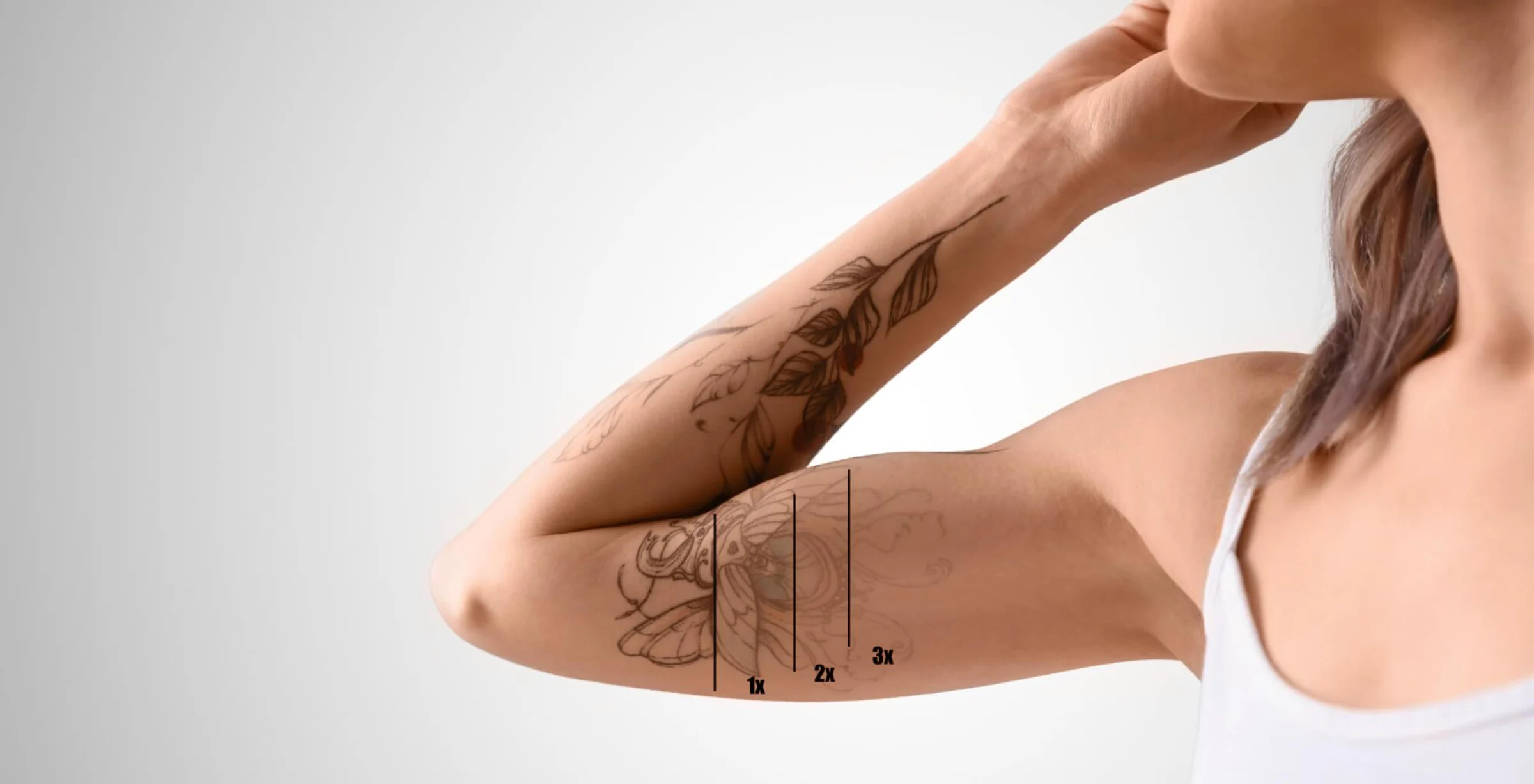
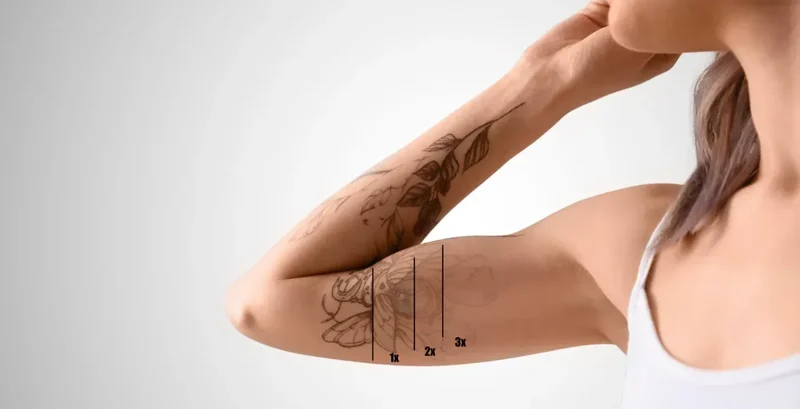
- The laser beam shatters the ink particles and the lymphatic system gradually clears them away, which is why the tattoo fades from session to session rather than disappearing all at once.
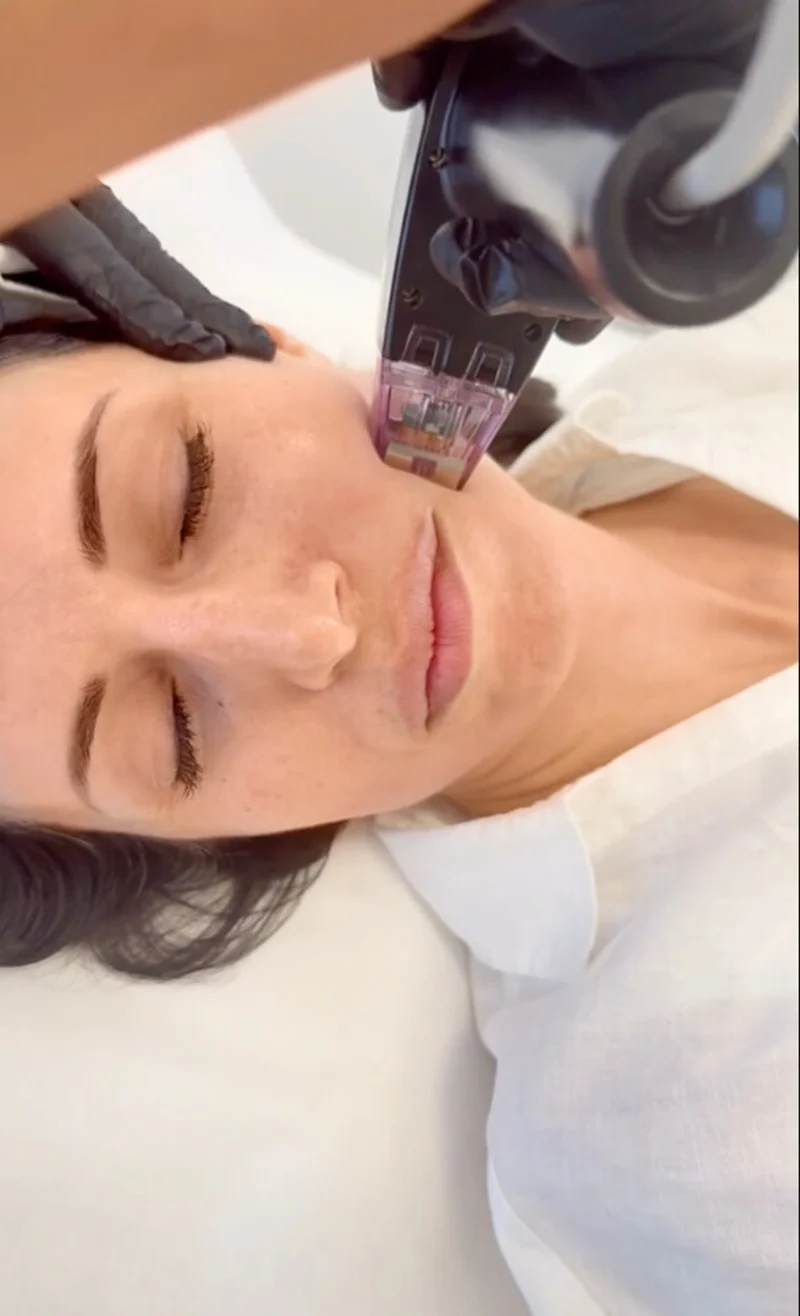
- Picosecond technology sends pulses 100 times shorter than nanosecond technology, breaking the ink down into tiny particles with a shock wave instead of heat.
- The average is 6 to 12 sessions at intervals of 6-8 weeks, and a colourful, complex tattoo may require 15 sessions or more.
- Black ink is the easiest to remove, while light colours such as yellow, white and turquoise, as well as green, are more challenging.
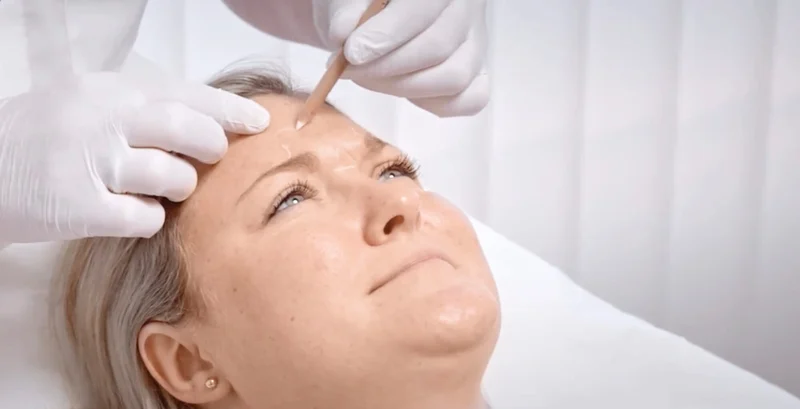
- The treatment takes just a few minutes with cold-air cooling and numbing as needed, and redness and swelling usually subside within 24 to 72 hours.
Have you decided it is time to part with an old tattoo? You are not alone. Laser tattoo removal is the most effective and safest way to achieve clear skin, but the process raises many questions. This guide, based on Dermacare's clinical experience, explains in a clear and professional way everything you need to know: how the laser beam breaks down the ink, why every tattoo responds differently, and what is required of you to achieve the best result.
How does laser tattoo removal work?
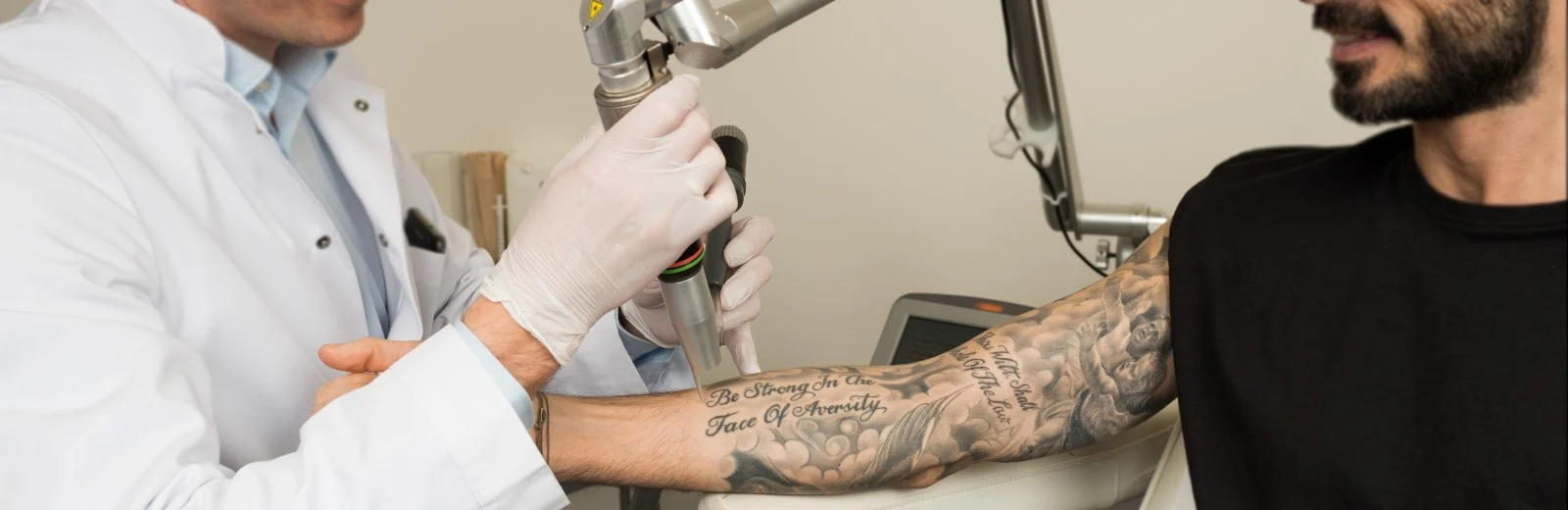
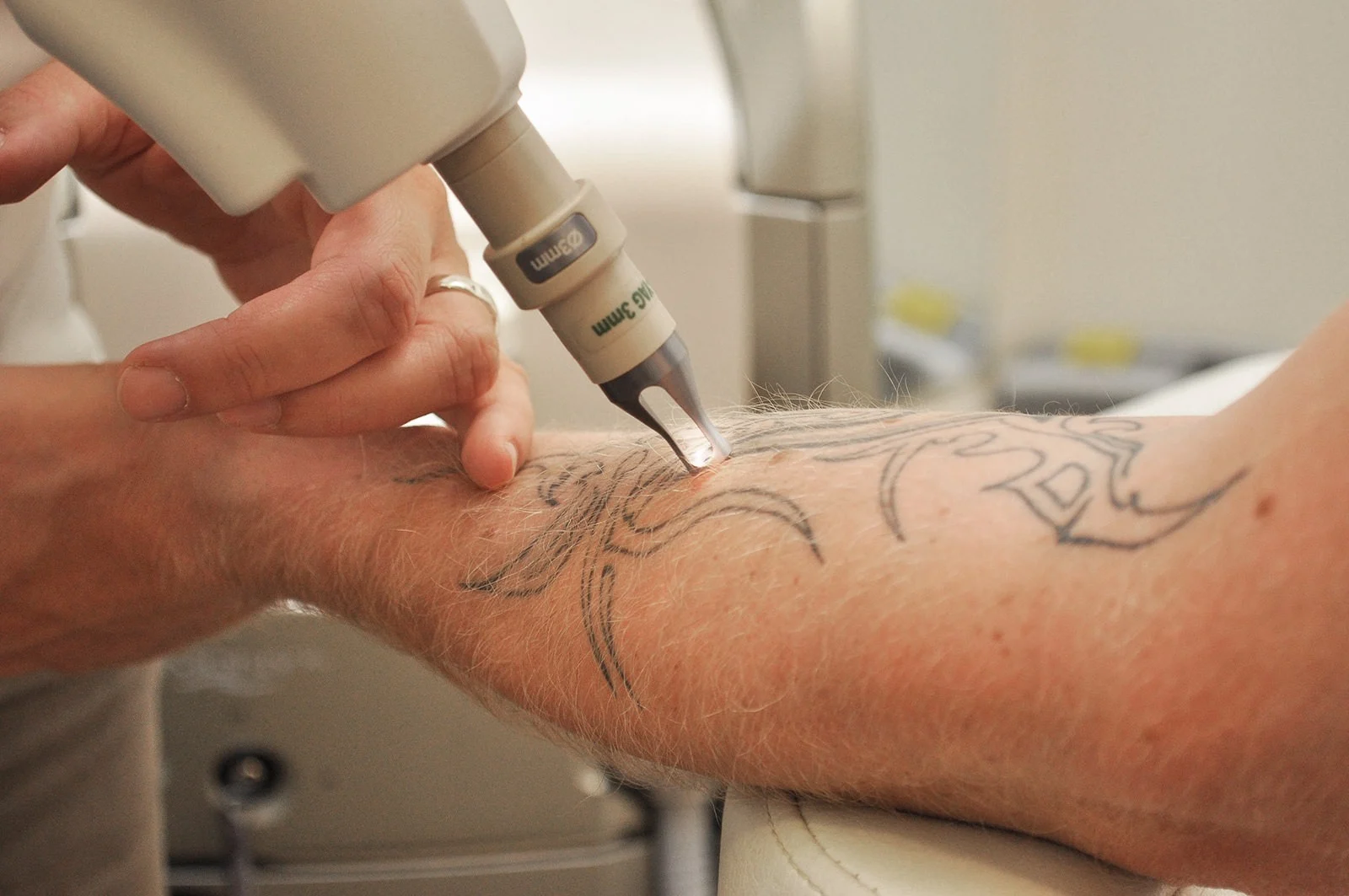
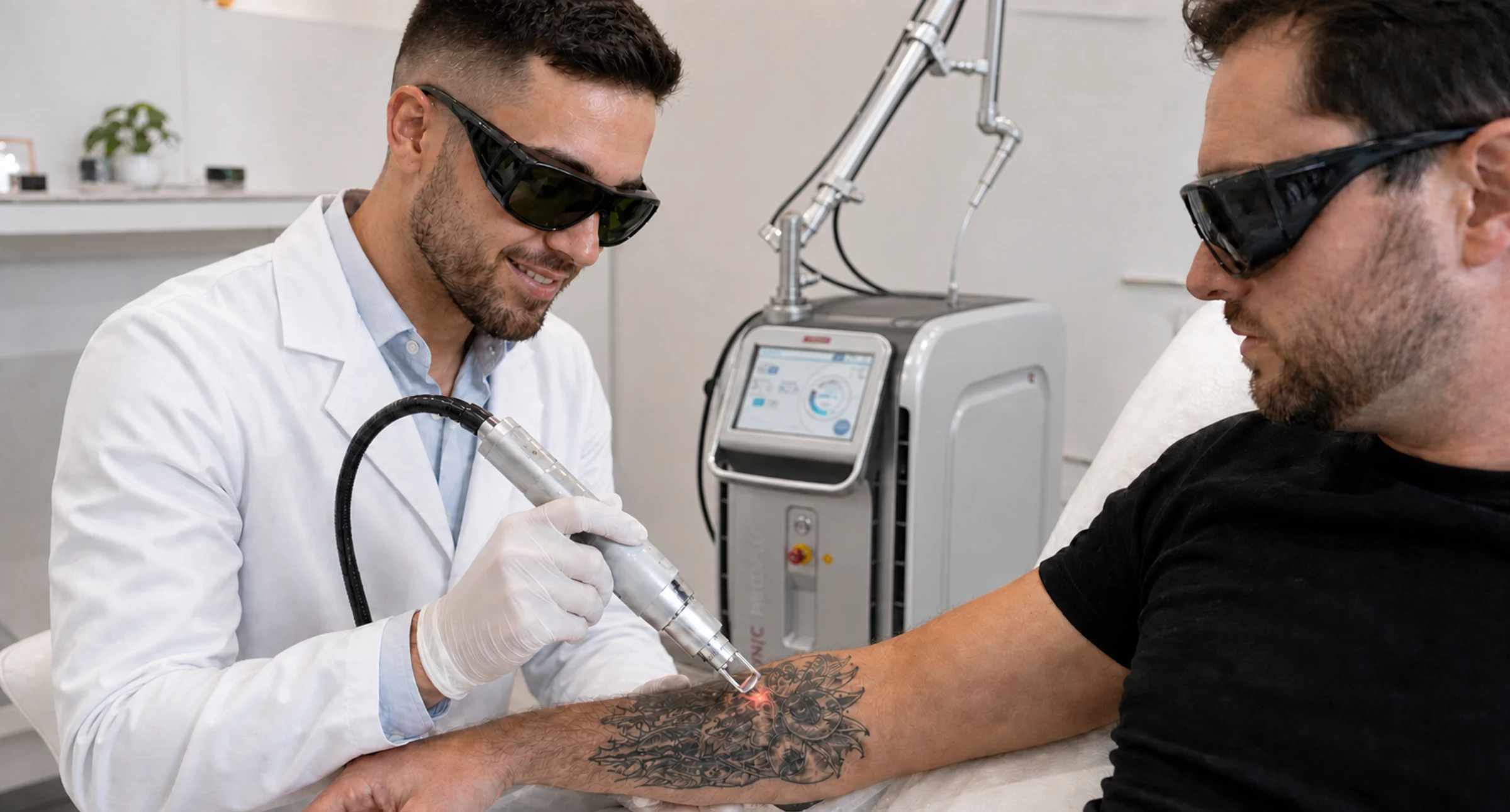
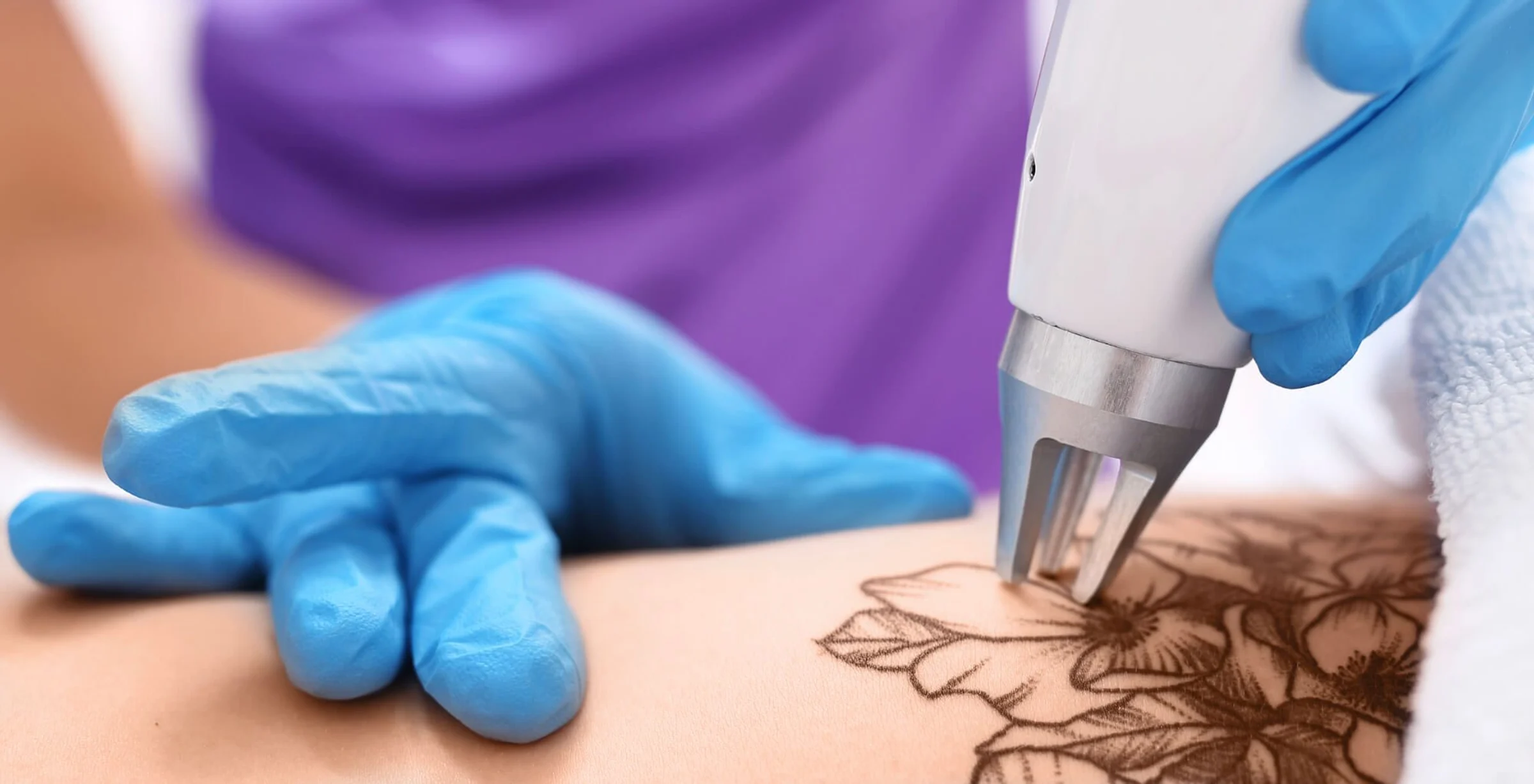
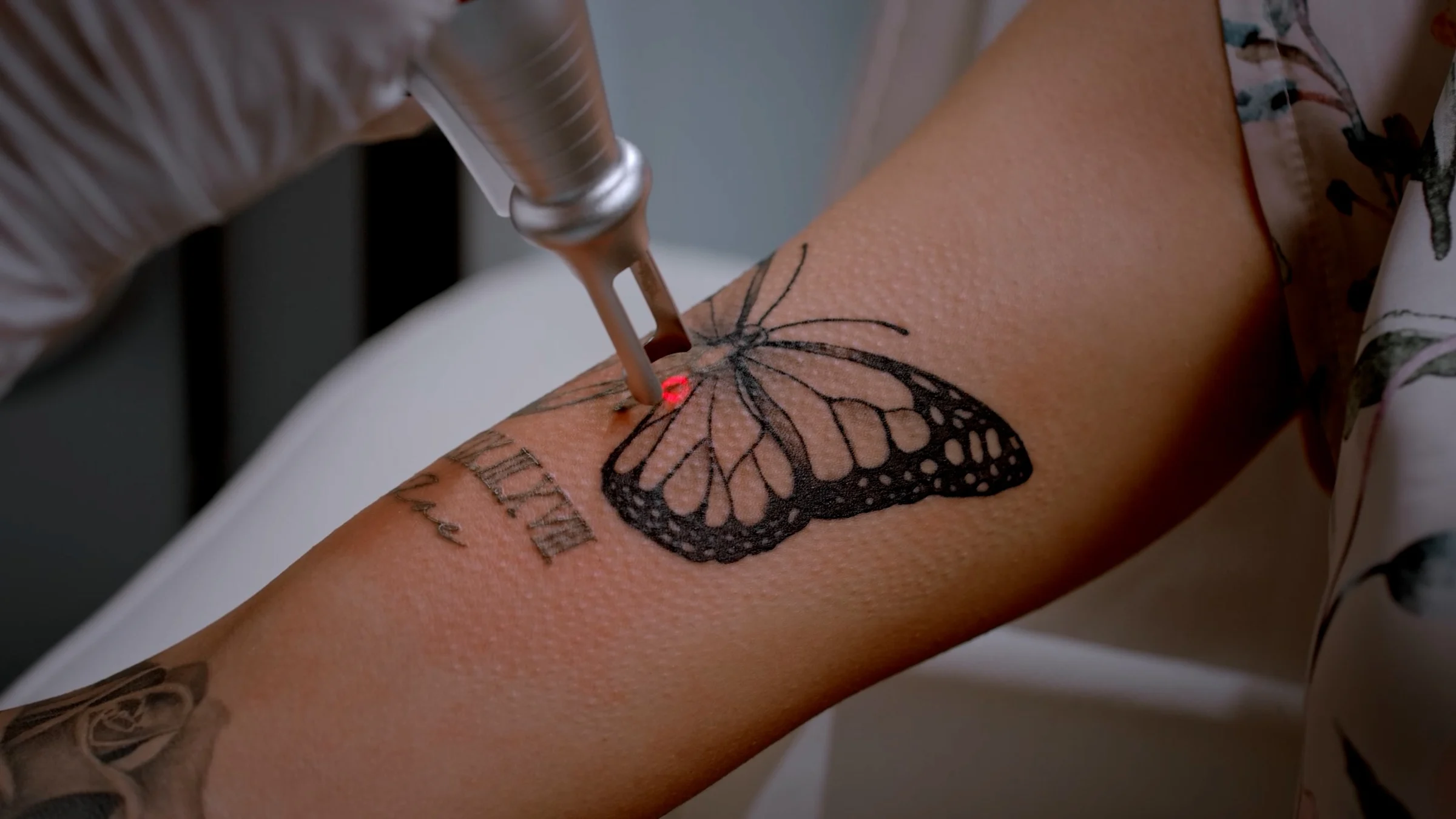
The principle behind laser tattoo removal is based on sophisticated technology that uses focused light energy. The device sends rapid, powerful pulses of light that penetrate the outer layer of the skin and are aimed directly at the ink particles "trapped" in the deep layer of the skin (the dermis).
Think of the ink in the skin as large rocks. The body does not know how to deal with them and clear them away. The laser beam acts like a precise jackhammer – it shatters these "rocks" into tiny fragments, almost like dust particles.
Once the ink has been broken down into tiny particles, the body's natural immune system goes into action. The white blood cells (the lymphatic system) identify the ink fragments as a foreign body to be cleared, "swallow" the particles and gradually remove them from the body. This is a completely natural biological process that takes place over several weeks. That is why the tattoo fades gradually from session to session, rather than disappearing all at once.
Key facts about the laser tattoo removal process
To give you a full and clear picture, we have gathered the most important points that every patient should know. Our goal at Dermacare is not only to provide excellent treatment, but to give you all the knowledge you need to make a considered decision that is right for you.
| Parameter | Description | Important points from Dermacare's clinical experience |
|---|---|---|
| Mechanism of action | A laser beam of a specific wavelength breaks down the ink particles in the skin. | We precisely match the wavelength to the ink colour. Black ink absorbs one wavelength, while colours such as red or green require different wavelengths to be broken down effectively. |
| The body's role | The immune (lymphatic) system clears the broken-down ink particles from the skin. | This is a process that requires time and patience. Intervals of 6-8 weeks between sessions are critical – they allow the body to "clean up" the area and prepare it for the next session. |
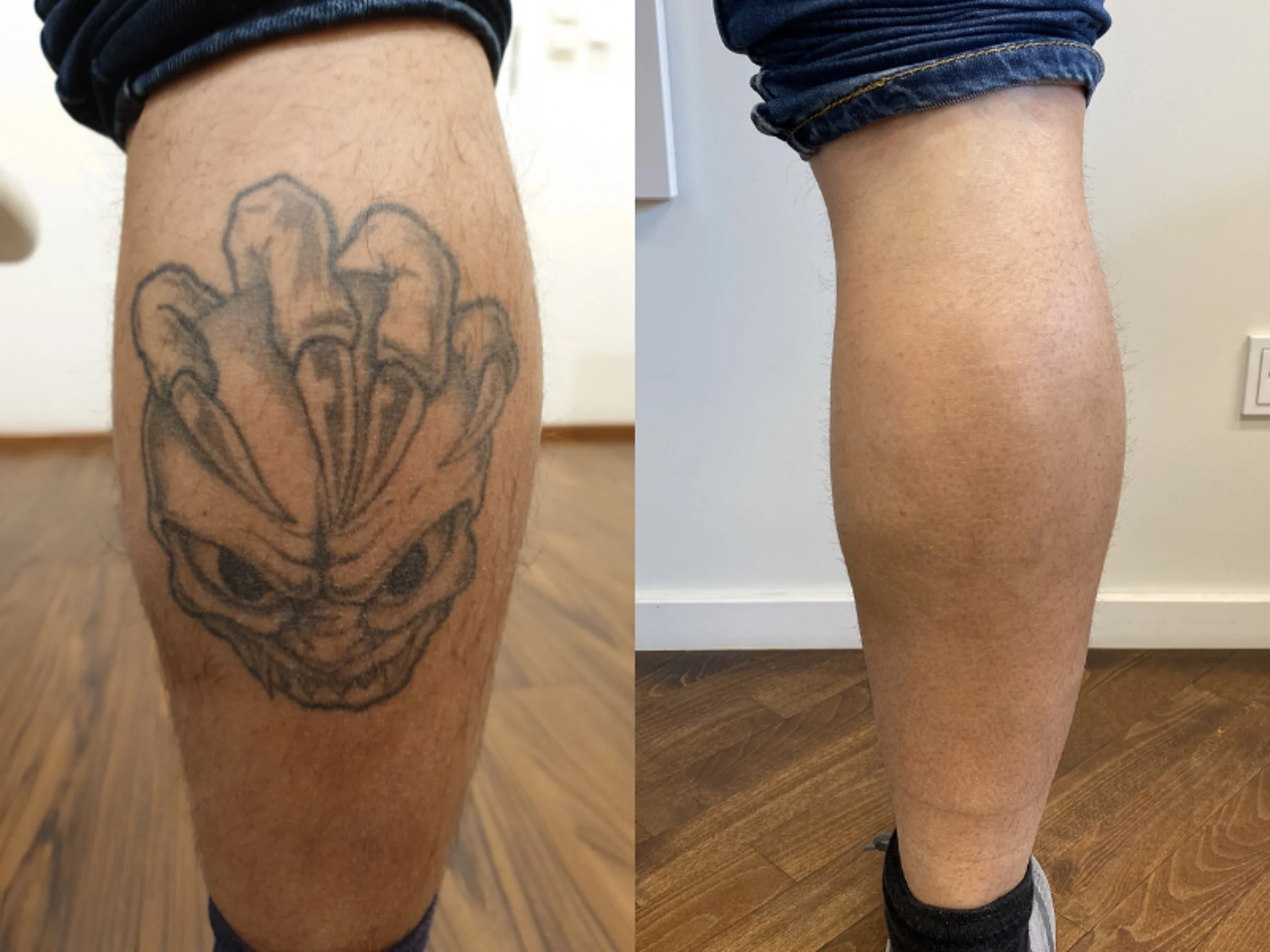
| The result | Gradual lightening of the tattoo from session to session, up to maximum removal. | The final result depends on many factors: the ink colours, the age of the tattoo, the skin type and even its location on the body. Setting realistic expectations is an essential part of the first consultation. |
| Safety | Modern technology targets the ink selectively, while preserving the surrounding tissue as much as possible. | In a professional clinic using advanced pico laser technologies, the risk of side effects such as scarring or changes in skin tone is minimal. |
This table is only the beginning. Every tattoo and every patient is a world of their own, and the success of the treatment depends on precisely tailoring the treatment protocol to the individual.
How does the laser know to target only the tattoo ink, and not the skin?
That is an excellent question, and the answer lies in a physical principle called selective photothermolysis. It sounds complicated, but the idea is simple. The laser is programmed to send a pulse of light at a precise wavelength that "interests" only the pigment (colour) of the tattoo and is absorbed selectively by it. The surrounding skin, which does not contain the same pigment, is barely affected by the laser energy.
Think of a black shirt on a hot summer's day. It heats up much more than a white shirt, because black "absorbs" all wavelengths of light. The laser works on exactly the same principle: it hits the target (the ink) while leaving the surrounding tissue unharmed.
Matching the wavelength to the ink colour
The tattoo's ink particles are the target, and each colour requires a different "weapon" to break it down effectively.
-
Black and dark blue ink: these are the easiest colours to remove. They readily absorb light at a wavelength of 1064 nm.
-
Red, orange and yellow ink: these warm colours require a different wavelength, 532 nm, to absorb the energy and break down.
-
Green and turquoise ink: these are considered the most challenging colours to remove. They require special wavelengths such as 585 or 650 nm, which are available only in advanced laser devices.
At the Dermacare clinic, we do not take a "one size fits all" approach. In the assessment appointment, we analyse the colour composition of the tattoo and put together a dedicated treatment protocol. For a multicoloured tattoo, we build a gradual plan, adjust the treatment parameters from session to session and closely monitor how the tissue responds. Our approach is to adapt the treatment to the tattoo, not the tattoo to the treatment.
The new generation: Pico (picosecond) technology
In the past, the leading technology was the Q-Switched laser, which operated with nanosecond pulses (a billionth of a second). These devices worked mainly through a thermal effect – heating the ink particles until they broke down. The heating caused more collateral damage to the skin and more pain, and required a longer recovery time.
Today, at Dermacare we use a laser with picosecond (Picosecond) technology, the newest and most advanced generation in the field. Pico technology sends pulses 100 times shorter than nanosecond technology. This speed creates a powerful photoacoustic effect (shock wave). Instead of heating the ink, the laser shatters it into tiny particles, just like fine dust, making it easier for the immune system to clear them.
The main differences between the technologies
| Feature | Q-Switched laser (old generation) | Picosecond laser (new generation) |
|---|---|---|
| Main mechanism of action | Thermal effect (heating) | Photoacoustic effect (shock wave) |
| Size of ink particles | Gravel-like particles | Dust-like particles |
| Clearance efficiency | Good | Significantly higher |
| Number of sessions required | Higher | Lower in many cases |
| Pain level | Higher | Reduced |
| Skin safety | Higher risk of collateral damage | Safer, less tissue damage |
Choosing an advanced technology such as pico laser means choosing a more effective, safer process with the potential for better results in fewer sessions. If you have a coloured tattoo, you can learn more about coloured tattoo removal with pico laser.
What factors affect the number of sessions required?
"How many sessions will it take?" This is the first question we hear in the consultation at Dermacare. The answer is that there is no "magic number". A superficial estimate such as "a palm-sized tattoo" is not enough, since there is a huge difference between a light, line-based design and an area densely filled with ink.
The success of the laser tattoo removal process depends on a combination of many variables, each of which dictates the rate of fading. To build a realistic treatment plan, we carry out an in-depth assessment.
Tattoo characteristics that affect the rate of removal
-
Ink colours: this is the most influential factor. Black ink is considered the easiest to remove. By contrast, light colours such as yellow, white or turquoise are the most challenging and require more patience and specific technology.
-
Age of the tattoo: surprisingly, older tattoos (over 10 years) are easier to remove in most cases. Over time, the body naturally breaks down some of the ink and the pigment becomes less stable.
-
Ink density and depth: a professional tattoo with high-quality ink applied at an even depth will be more challenging to remove than an amateur, superficial tattoo. A line tattoo will respond faster than a "sleeve" full of ink.
-
Cover-up tattoos: in these cases, we are dealing with double layers of ink, which makes the process more complex and requires more sessions.
From our experience at Dermacare, certain colours such as shades of green and turquoise are more challenging. Our approach is based on precise assessment, honest expectation setting, adapting the technology and parameters, and building a patient, gradual process. Instead of promising an unrealistic result, we focus on maximising the possible lightening while protecting the safety of the skin.
Patient-related factors
-
Skin tone: fair skin is easier and safer to treat. In darker skin, the risk of pigmentation changes is higher, so extra caution, more moderate intensities and sometimes more sessions are required.
-
Location of the tattoo: tattoos in areas with good blood flow (chest, back, shoulders) will lighten faster. Tattoos on the extremities (ankles, fingers) will lighten more slowly because of weaker lymphatic activity.
-
Health and lifestyle: a strong immune system is your best ally. Healthy non-smokers will usually see faster results. Smoking, for example, impairs blood flow and slows the body's ability to clear the ink.
So how long will it actually take? The average usually ranges between 6 and 12 sessions, with an interval of 6-8 weeks between them. It is important to remember that this is only an estimate. A small, superficial black tattoo may respond well after just a few sessions, while a colourful, complex sleeve may require 15 sessions or more.
Does the treatment hurt, and what are the side effects?
"How much does it hurt?" is a legitimate question. Laser tattoo removal is not a spa treatment, and it involves some discomfort. However, the sensation is entirely bearable and lasts only a few minutes. Most patients describe it as a small, quick burning sensation, or like a rubber band lightly snapping against the skin. The discomfort is felt only while the laser is operating and disappears almost immediately when it stops.
How do we ease the sensation at Dermacare?
We understand the fear of pain and have built a treatment protocol that makes the experience as calm and comfortable as possible:
-
Cold-air cooling system: throughout the treatment, we use a device that blows freezing air (down to minus 30 degrees) over the area. The cold numbs the skin in real time and significantly reduces the burning sensation.
-
Local anaesthesia (if needed): for people with a low pain threshold or in particularly delicate areas, a numbing cream can be applied about 15 minutes to 2 hours before the treatment begins.
-
Fast, precise treatment: thanks to our advanced technology, the treatment is efficient and targeted, keeping the duration of discomfort to a minimum.
Expected side effects and recovery
After the treatment, the skin's reaction is a positive sign that the process is working. The side effects are a natural part of healing and are temporary.
-
Redness and swelling: immediately after the treatment the area will be red and swollen, similar to mild sunburn. These effects usually subside within 24 to 72 hours.
-
Temporary whitening (frosting): when the laser hits the skin, a white layer will appear on the tattoo. This is a natural chemical reaction caused by gas being released from the skin, and it disappears within minutes.
-
Blisters and scabs: small blisters or scabs are not expected when the treatment is performed with pico technology. However, they may occur if high energy is used and the area is not cooled after the treatment. The most important rule: do not pop blisters or pick scabs! Allow them to heal naturally to prevent infection or scarring.
At the end of each treatment, you will receive precise home-care instructions from us, which sometimes include a recommendation for creams such as Bepanthen Plus that help soothe the skin and promote fast, smooth healing.
Rare risks and complications
When laser tattoo removal is performed in a professional clinic with advanced equipment and an experienced team, the risks are minimal. Complications usually occur with unprofessional treatment or as a result of not following the aftercare instructions.
-
Infection: may occur if hygiene is not maintained or if the area is "fiddled with".
-
Changes in skin tone (pigmentation): light patches (hypopigmentation) or dark patches (hyperpigmentation) may occur. The risk is higher in people with darker skin, but an experienced practitioner knows how to choose the right parameters to minimise this risk.
-
Scarring: a very rare risk with modern pico laser technologies, which may be caused by using excessive intensities or aggressive treatment – things that do not happen under Dermacare's careful protocol.
The tattoo removal process at Dermacare: step by step
At Dermacare there are no shortcuts. Our goal is not just to "erase" the tattoo, but to do so in the safest and most appropriate way for your skin. Together we build a transparent, personal plan, understanding that your trust is our most important asset.
Step 1: Assessment and personal consultation
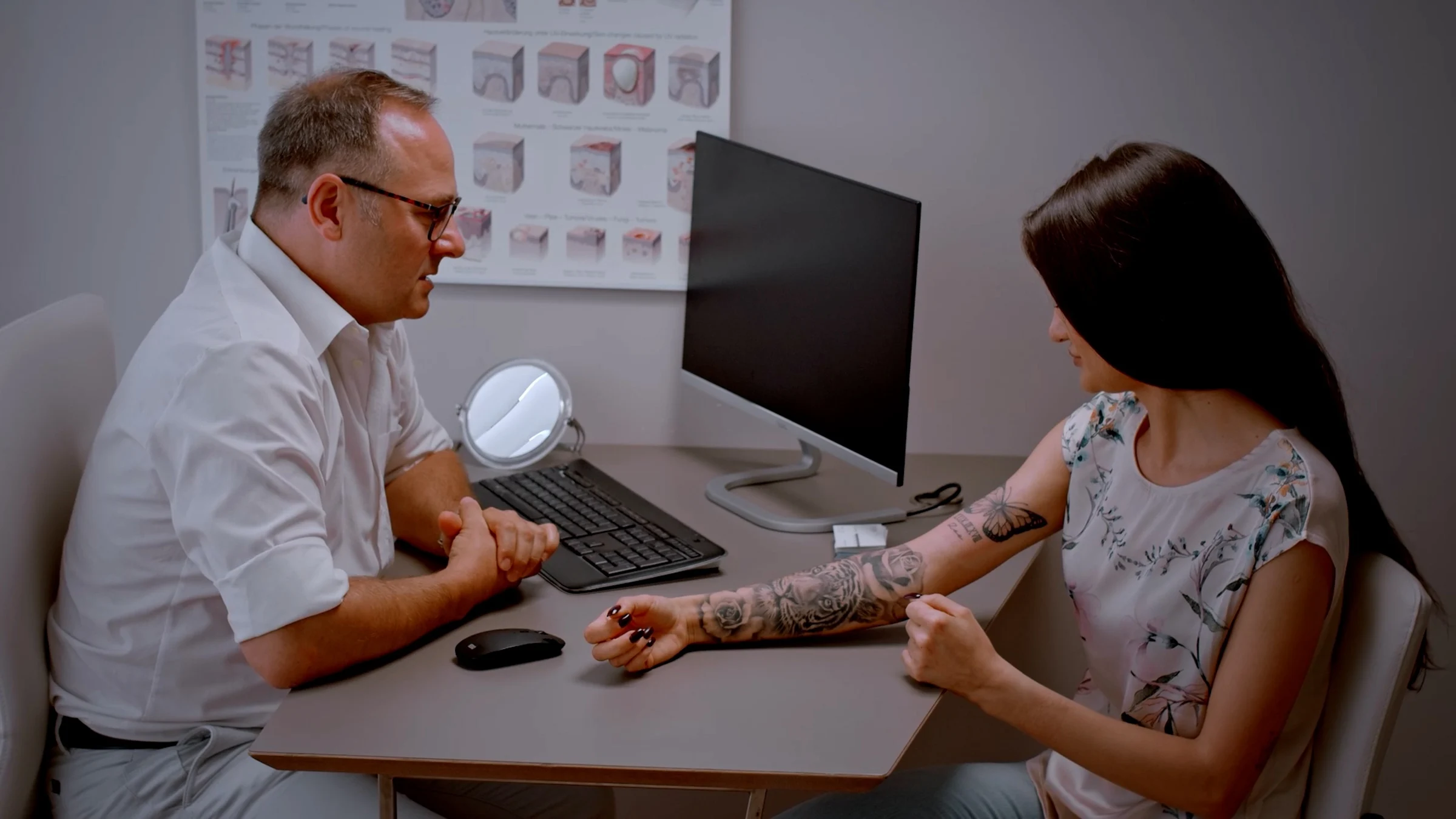
This is the most important appointment in the process, where we lay the foundations for success. In this appointment, we carry out a comprehensive assessment of the tattoo and the skin.
What do we check?
-
Skin type: assessing skin tone according to the Fitzpatrick scale allows us to adjust the laser intensity precisely, prevent risk and safely treat even dark or sensitive skin.
-
The tattoo itself: we examine all its characteristics – the ink colours, the age of the tattoo, the ink density and its depth in the skin.
-
Medical history: a review of your medical background to make sure there are no conditions that could affect the treatment or recovery.
At the end of the appointment, you will receive a personal treatment plan and realistic expectations, including an estimate of the number of sessions required and the intervals between them.
Step 2: The treatment
During the treatment, everything is focused, quick and controlled to ensure a calm, comfortable experience.
-
Preparation and disinfection: thorough cleaning and disinfection of the treatment area.
-
Cooling and numbing: an advanced air-cooling system is used to reduce discomfort.
-
The laser treatment: the procedure itself is short and takes a few minutes, depending on the size of the tattoo.
-
Soothing and dressing: further cooling of the area and a sterile dressing with an antibacterial ointment if needed.
Our emphasis at Dermacare is on a careful, non-aggressive medical approach. The goal is not "as fast as possible", but "as correctly and safely as possible". We readjust the laser parameters at every session according to the skin's response and the rate at which the tattoo is fading.
Step 3: Recovery and aftercare instructions
Success depends on our professionalism and your responsibility. Following the aftercare instructions is a critical part of the process.
-
Keep it clean and dry: keep the area clean and wash it gently with soap and water.
-
Use an ointment: it is recommended to apply a soothing, antibacterial ointment (such as Bepanthen Plus) where the skin itches, as instructed.
-
Avoid sun exposure completely: this is essential to prevent pigmentation. Use a high-factor sunscreen.
-
Hands off! Do not scratch, pick scabs or pop blisters.
The Dermacare team provides close support and is available for any questions throughout the process, until the final result is achieved.
How much does laser tattoo removal cost?
The question of price is important, and at Dermacare we believe in full transparency. There is no single price for laser tattoo removal; the cost is individual and is determined in the assessment appointment. The price per session depends mainly on the size of the tattoo, its complexity (number of colours and depth of ink) and the technology required.
Average price ranges per session
These are general estimates only. The final price will be set only after a professional assessment:
-
Small tattoo: from ILS 250 per session
-
Medium tattoo: from ILS 400 per session
-
Large tattoo: from ILS 800 per session
Treatment packages and the full picture
Tattoo removal is a process, so buying a package of sessions in advance is almost always the most cost-effective option. At Dermacare we offer treatment packages with significant discounts, making the process more accessible.
It is important to understand: investing in advanced technology and an experienced team is a direct investment in your safety and your result. A price that is "too cheap" should set off alarm bells. Unprofessional treatment can cause irreversible damage to the skin.
We recommend weighing the quote against what you get: the security, accountability and support of an accredited clinic. You can find more details in our tattoo removal price list.
In summary:
Tattoo removal is a significant process that improves quality of life and self-confidence. Choosing a professional clinic with an emphasis on precise assessment, personalised treatment and advanced technology is critical to the success of the process. The final result depends on the experience and skill of the treating team, as well as on following the instructions and staying consistent with the sessions.
Want to understand which plan is right for treating your tattoo? The Dermacare team will be happy to carry out a professional assessment, check the type of ink and skin, and explain what to expect in a responsible, personal and precise way. To book a consultation, you can contact us here.
Eduard Yusupov, manager of the Dermacare clinic network and an expert in aesthetic medicine and laser treatments. His areas of expertise include tattoo lightening and removal using advanced laser technologies.
Medical disclaimer: the information in this article is for informational purposes only and is not a substitute for medical advice. Every treatment requires an individual examination and tailoring to the patient's health and skin condition. The article was edited and medically reviewed by the expert Eduard Yusupov and was last updated in March 2026.
Frequently asked questions
Absolutely. Our technology allows maximum precision, just like a targeted "eraser". We can treat only a specific area of the tattoo, whether to remove a name, correct a mistake, or lighten before a cover-up.
Yes, in most cases. Tattoos that are 10 years old or more are easier to remove. Over time, the body naturally breaks down some of the ink, and the pigments become less stable, which makes it easier for the laser to break them down.
Absolutely possible. Once the skin has finished healing completely, there is no reason not to tattoo a new design. We recommend waiting at least 3-6 months after the last treatment in the series to ensure the skin has fully recovered.
Black, dense tattoos are excellent candidates for treatment, since black absorbs laser energy best. However, because of the large amount of ink, the process will require more treatments and patience compared with a thin, linear tattoo.
Yes. Our technology is also highly effective for removing or lightening permanent make-up, such as eyeliner, tattooed eyebrows or lip contouring. Treatment of these delicate areas requires exceptionally high skill, the use of adapted protocols and dedicated protective equipment. The experience we have gained at Dermacare allows us to carry out these treatments safely and with maximum precision.